EXPERIMENTS WITH ALTERNATE CURRENTS OF VERY HIGH
FREQUENCY AND THEIR APPLICATION TO METHODS OF ARTIFICIAL ILLUMINATION
Delivered
before the American Institute of Electrical Engineers, Columbia College, N.Y.,
May 20, 1891.
There is no subject more captivating, more worthy of study,
than nature. To understand this great
mechanism, to discover the forces which are active, and the laws which govern
them, is the highest aim of the intellect of man.
Nature has stored up in the universe infinite energy. The eternal recipient and transmitter of
this infinite energy is the ether. The
recognition of the existence of ether, and of the functions it performs, is one
of the most important results of modern scientific research. The mere abandoning of the idea of action at
a distance, the assumption of a medium pervading all space and connecting all
gross matter, has freed the minds of thinkers of an ever present doubt, and, by
opening a new horizon—new and unforeseen possibilities—has given fresh interest
to phenomena with which we are familiar of old. It has been a great step towards the understanding of the forces
of nature and their multifold manifestations to our senses. It has been for the enlightened student of
physics what the understanding of the mechanism of the firearm or of the steam
engine is for the barbarian. Phenomena
upon which we used to look as wonders baffling explanation, we now see in a
different light. The spark of an
induction coil, the glow of an incandescent lamp, the manifestations of the
mechanical forces of currents and magnets are no longer beyond our grasp;
instead of the incomprehensible, as before, their observation suggests now in
our minds a simple mechanism, and although as to its precise nature all is
still conjecture, yet we know that the truth cannot be much longer hidden, and
instinctively we feel that the understanding is dawning upon us. We still admire these beautiful phenomena,
these strange forces, but we are helpless no longer; we can in a certain
measure explain them, account for them, and we are hopeful of finally
succeeding in unraveling the mystery which surrounds them.
In how far we can understand the world around us is the
ultimate thought of every student of nature.
The coarseness of our senses prevents us from recognizing the ulterior
construction of matter, and astronomy, this grandest and most positive of
natural sciences, can only teach us something that happens, as it were, in our
immediate neighborhood; of the remoter portions of the boundless universe, with
its numberless stars and suns, we know nothing, But far beyond the limit of
perception of our senses the spirit still can guide us, and so we may hope that
even these unknown worlds—infinitely small and great—may in a measure became
known to us. Still, even if this
knowledge should reach us, the searching mind will find a barrier, perhaps
forever unsurpassable, to the true recognition
of that which seems to be, the mere appearance of which is the only and
slender basis of all our philosophy.
Of all the forms of nature's immeasurable, all-pervading
energy, which ever and ever changing and moving; like a soul animates the inert
universe, electricity and magnetism are perhaps the most fascinating. The effects of gravitation, of heat and
light we observe daily, and soon we get accustomed to them, and soon they lose
for us the character of the marvelous and wonderful; but electricity and
magnetism, with their singular relationship, with their seemingly dual
character, unique among the forces in nature, with their phenomena of
attractions, repulsions and rotations, strange manifestations of mysterious
agents; stimulate and excite the mind to thought and research. What is electricity, and what is magnetism? These questions have been asked again and
again. The most able intellects have
ceaselessly wrestled with the problem; still the question has not as yet been
fully answered. But while we cannot
even to-day state what these singular forces are, we have made good headway
towards the solution of the problem. We
are now confident that electric and magnetic phenomena are attributable to
ether, and we are perhaps justified in saying that the effects of static
electricity are effects of ether under strain, and those of dynamic electricity
and electro-magnetism effects of ether in motion. But this still leaves the question, as to what electricity and
magnetism are, unanswered.
First, we naturally inquire, What is electricity, and is
there such a thing as electricity? In
interpreting electric phenomena: we may speak of electricity or of an electric
condition, state or effect. If we speak
of electric effects we must distinguish two such effects, opposite in character
and neutralizing each other, as observation shows that two such opposite
effects exist. This is unavoidable, for
in a medium of the properties of ether, we cannot possibly exert a strain, or
produce a displacement or motion of any kind, without causing in the
surrounding medium an equivalent and opposite effect. But if we speak of electricity, meaning a thing, we must, I think, abandon the idea of two electricities,
as tie existence of two such things is highly improbable. For how can we imagine that there should be
two things, equivalent in amount, alike in their properties, but of opposite
character, both clinging to matter, both attracting and completely neutralizing
each other? Such an assumption, though
suggested by many phenomena, though most convenient for explaining them, has
little to commend it. If there is such a thing as electricity, there
can be only one such thing, and;
excess and want of that one thin, possibly; but more probably its condition
determines the positive and negative character. The old theory of Franklin, though falling short in some
respects; is, from a certain point of view, after all, the most plausible
one. Still, in spite of this, the
theory of the two electricities is generally accepted, as it apparently
explains electric phenomena in a more satisfactory manner. But a theory which better explains the facts
is not necessarily true. Ingenious
minds will invent theories to suit observation, and almost every independent
thinker has his own views on the subject.
It is not with the, object of advancing an opinion; but with
the desire of acquainting you better with some of the results, which I will
describe, to show you the reasoning I have followed, the departures I have
made—that I venture to express, in a few words, the views and convictions which
have led me to these results.
I adhere to the idea that there is a thing which we have
been in the habit of calling electricity.
The question is, What is that thing?
or, What, of all things, the existence of which we know, have we the
best reason to call electricity? We
know that it acts like an incompressible fluid; that there must be a constant
quantity of it in nature; that it can be neither produced nor destroyed; and,
what is more important, the electro-magnetic theory of light and all facts
observed teach us that electric and ether phenomena are identical. The idea at once suggests itself, therefore,
that electricity might be called ether.
In fact, this view has in a certain sense been advanced by Dr. Lodge. His interesting work has been read by
everyone and many have been convinced by his arguments. Isis great ability and the interesting
nature of the subject, keep the reader spelbound; but when the impressions
fade, one realizes that he has to deal only with ingenious explanations. I must confess, that I cannot believe in two
electricities, much less in a doubly-constituted ether. The puzzling behavior of tile ether as a
solid waves of light anti heat, and as a fluid to the motion of bodies through
it, is certainly explained in the most natural and satisfactory manner by
assuming it to be in motion, as Sir William Thomson has suggested; but
regardless of this, there is nothing which would enable us to conclude with
certainty that, while a fluid is not capable of transmitting transverse
vibrations of a few hundred or thousand per second, it might not be capable of
transmitting such vibrations when they range into hundreds of million millions
per second. Nor can anyone prove that
there are transverse ether waves emitted from an alternate current machine, giving a small number of
alternations per second; to such slow disturbances, the ether, if at rest, may
behave as a true fluid.
Returning to the subject, and bearing in mind that the
existence of two electricities is, to say the least, highly improbable, we must
remember, that we have no evidence of electricity, nor can we hope to get it,
unless gross matter is present.
Electricity, therefore, cannot be called ether in the broad sense of the
term; but nothing would seem to stand in the way of calling electricity ether associated with matter, or bound
other; or, in other words, that the so-called static charge of the molecule is
ether associated in some way with the molecule. Looking at it in that light, we would be justified in saying,
that electricity is concerned in all molecular actions.
Now, precisely what the ether surrounding tine molecules is,
wherein it differs from ether in general, can only be conjectured. It cannot differ in density, ether being
incompressible; it must, therefore, be under some strain or is motion, and the
latter is the` most probable: To understand its functions, it would be
necessary to have an exact idea of the physical construction of matter, of
which, of course, we can only form a mental picture.
But of all the views on nature, the one which assumes one
matter and one force, and a perfect uniformity throughout, is the most
scientific.and most likely to be true.
An infinitesimal world, with the molecules and their atoms spinning and
moving in orbits, in much the same manner as celestial bodies, carrying with
them and probably spinning with them ether, or in other words; carrying with
them static charges, seems to my mind the most probable view, and one which; in
a plausible manner, accounts for most of the phenomena observed. The spinning of the molecules and their
ether sets up the ether tensions or electrostatic strains; the equalization of
ether tensions sets up ether motions or electric currents, and the orbital
movements produce the effects of electro and permanent magnetism.
About fifteen, years ago, Prof. Rowland demonstrated a most
interesting and important fact; namely, that a static charge carried around
produces the effects of an electric current.
Leaving out of consideration the precise nature of the mechanism, which
produces the attraction and repulsion of currents, and conceiving the
electrostatically charged molecules in motion, this experimental fact gives us
a fair idea of magnetism. We can
conceive lines or tubes of force which physically exist, being formed of rows
of directed moving molecules; we can see that these lines must be closed, that
they must tend to shorten and expand, etc.
It likewise explains in a reasonable way, the most puzzling
phenomenon. of all, permanent magnetism,
and, in general, has all the beauties of the Ampere theory without possessing the vital defect of the same, namely, the
assumption of molecular currents.
Without enlarging further upon the subject, I would say, that I look
upon all electrostatic, current and magnetic phenomena as being due to
electrostatic molecular forces.
The preceding remarks I have deemed necessary to a full
understanding; of the subject a s it presents itself to my mind.
Of all these phenomena the most important to study' are the
current phenomena, on account of the already extensive and evergrowing use of
currents for industrial purposes. It is
now a century since the first practical source of current was produced, and,
ever since, the phenomena which accompany the flow of currents have been
diligently studied, and through the untiring efforts of scientific men the
simple laws which govern them have been discovered. But these laws are found to hold good only when the currents are
of a steady character. When the
currents are rapidly varying in strength, quite different phenomena, often
unexpected, present themselves, and quite different laws hold good, which even
now have not been determined as fully as is desirable, though through the work,
principally, of English scientists, enough knowledge has been gained on the
subject to enable us to treat simple cases which now present themselves in
daily practice.
The phenomena which are peculiar to the changing character
of the currents are greatly exalted when the rate of change is increased, hence
the study of these currents is considerably facilitated by the employment of
properly constructed apparatus. It was
with this and other objects in view that I constructed alternate current
machines capable of giving more than two million reversals of current per
minute, and to this circumstance it is principally due, that I am able to bring
to your attention some of the results thus far reached; which I hope will prove
to be a step in advance on account of their direct bearing upon one of the most
important problems, namely, the production of a practical and efficient source
of light.
The study of such rapidly alternating currents is very
interesting. Nearly every experiment
discloses something new. Many results
may, of course, be predicted, but many more are unforeseen. The experimenter makes many interesting observations. For instance, we take a piece of iron and
hold it against a magnet. Starting from
low alternations and running up higher and higher we feel the impulses succeed
each other faster and faster, get weaker and weaker, and finally
disappear. We then observe a continuous
pull; the pull, of course, is not continuous; it only appears so to us; our
sense of touch is imperfect.
We may next establish an arc between the electrodes and
observe, as the alternations rise, that the note which accompanies alternating
arcs gets shriller and shriller, gradually weakens, and finally ceases. The air vibrations, of course, continue, but
they are too weak to be perceived; our sense of hearing fails us.
We observe the small physiological effects, the rapid heating
of the iron cores and conductors, curious inductive effects, interesting
condenser phenomena, and still more interesting light phenomena with a high
tension induction coil. All these
experiments and observations would be of the greatest interest to the student,
but their description would lead me too far from the principal subject. Partly for this reason, and partly on
account of their vastly greater importance, I will confine myself to the
description of the light effects produced by these currents.
In the experiments to this end a high tension induction coil
or equivalent apparatus for converting currents of comparatively low into
currents of high tension is used.
If you will be sufficiently interested in the results I shall
describe as to enter into an experimental study of this subject; if you will be
convinced of the truth of the arguments I shall advance—your aim will be to
produce high frequencies and high potentials; in other words, powerful
electrostatic effects. You will then
encounter many difficulties, which, if completely overcome, would allow us to
produce truly wonderful results.
First will be met the difficulty of obtaining the required
frequencies by means of mechanical apparatus, and, if they be obtained
otherwise, obstacles of a different nature will present themselves. Next it will be found difficult to provide
the requisite insulation without considerably increasing the size of the
apparatus, for the potentials required are high, and, owing to the rapidity of
the alternations, the insulation presents peculiar difficulties. So, for instance, when a gas is present, the
discharge may work, by the molecular bombardment of the gas and consequent
heating, through as much as an inch of the best solid insulating material, such
as glass, hard rubber, porcelain, sealing wax, etc.; in fact, through any known
insulating substance. The chief
requisite in the insulation of the apparatus is, therefore, the exclusion of
any gaseous matter.
In general my experience tends to show that bodies which
possess the highest specific inductive capacity, such as glass, afford a rather
inferior insulation to others, which, while they are good insulators, have a
much smaller specific inductive capacity, such as oils, for instance, the
dielectric losses being no doubt greater in the former. The difficulty of insulating, of course,
only exists when the potentials are excessively high, for with potentials such
as a few thousand volts there is no particular difficulty encountered in conveying
currents from a machine giving, say, 20,000 alternations per second, to quite a
distance. This number of alternations,
however, is by far too small for many purposes, though quite sufficient for
some practical applications. This
difficulty of insulating is fortunately not a vital drawback; it affects mostly
the size of the apparatus, for, when excessively high potentials would be used,
the light-giving devices would be located not far from the apparatus, and often
they would be quite close to it. As the
air-bombardment of the insulated wire is dependent on condenser action, the
loss may be reduced to a trifle by using excessively thin wires heavily
insulated.
Another difficulty will be encountered in the capacity and
self-induction necessarily possessed by the coil. If the toil be large, that is, if it contain a great length of
wire, it will be generally unsuited for excessively high frequencies; if it be
small, it may be well adapted for such frequencies, but the potential might
then not be as high as desired. A good
insulator, and preferably one possessing a small specific inductive capacity,
would afford a two-fold advantage.
First, it would enable us to construct a very small coil capable of
withstanding enormous differences of potential; and secondly, such a small
coil, by reason of its smaller capacity and self-induction, would be capable of
a quicker and more vigorous vibration.
The problem then of constructing a coil or induction apparatus of any
kind possessing the requisite qualities I regard as one of no small importance,
and it has occupied me for a considerable time.
The investigator who desires to repeat the experiments which
I will describe, with an alternate current machine, capable of supplying
currents of the desired frequency, and an induction coil, will do well to take
the primary coil out and mount the secondary in such a manner as to be able to
look through the tube upon which the secondary is wound. He will then be able to observe the streams
which pass from the primary to the insulating tube, and from their intensity he
will know how far he can strain the coil.
Without this precaution he is sure to injure the insulation. This arrangement permits, however, an easy
exchange of the primaries, which is desirable in these experiments.
The selection of the type of machine best suited for the
purpose must be left to the judgment of the experimenter. There are here illustrated three distinct
types of machines, which, besides others, I have used in my experiments.
Fig. 1 represents the machine used in my experiments before
this Institute. The field magnet
consists of a ring of wrought iron with 384 pole projections. The armature comprises a steel disc to which
is fastened a thin, carefully welded rim of wrought iron. Upon the rim are wound several layers of
fine, well annealed iron wire, which, when wound, is passed through
shellac. The armature wires are wound
around brass pins, wrapped with silk thread: The diameter of the armature wire
in this type of machine should not be more than 1/8. of the thickness of the pole projections, else the local action
will be considerable.
Fig. 2 / 97 represents a larger machine of a different
type. The field magnet of this machine
consists of two like parts which either enclose an exciting coil, or else are
independently wound. Each part has 480
pole projections, the projections of one facing those of the other. The armature consists of a wheel of hard bronze,
carrying the conductors which revolve between the projections of the field magnet. To wind the armature conductors, I have
found it most convenient to proceed in the following manner. I construct a ring of hard bronze of the
required size. This ring and the rim a
the wheel are provided with the proper number of pins, and both fastened upon a
plate. The armature conductors being
wound, the pins are cut off and the ends of the conductors fastened by two
rings which screw to the bronze ring and the rim of the wheel, respectively. The whole may then be taken off and forms a
solid structure. The conductors in such
a type of machine should consist of sheet copper, the thickness of which, of
course, depends on the thickness of the pale projections; or else twisted thin
wires should be employed.
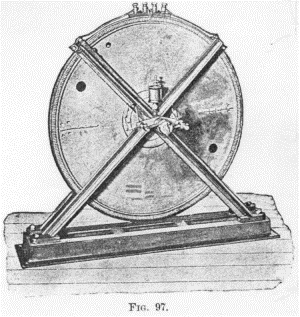
Fig. 3 is a smaller machine, in many respects similar to the
former, only here the armature conductors and the exciting coil are kept
stationary, while only a block of wrought iron is revolved.
It would be uselessly lengthening this description were I to
dwell more on the details of construction of these machines. Besides, they have been described somewhat
more elaborately in The Electrical
Engineer, of March 18, 1891. I deem
it well, however, to call the attention of the investigator to two things, the
importance of which, though self evident, he is nevertheless apt to
underestimate; namely, to the local action in the conductors which must be
carefully avoided, and to the clearance, which must be small. I may add, that since it is desirable to use
very high peripheral speeds, the armature should he of very large diameter in
order to avoid impracticable belt speeds.
Of the several types of these machines which have been constructed by
me, I have found that the type illustrated in Fig. 1 caused me the least
trouble in construction, as well as in maintenance, and on the whole, it has
been a good experimental machine.
In operating an induction coil with very rapidly alternating currents, among the first luminous
phenomena noticed are naturally those, presented by the high-tension discharge. As the number of alternations per second is
increased, or as—the number being high—the current through the primary is
varied, the discharge gradually changes in appearance. It would be difficult to describe the minor
changes which occur, and the conditions which bring them about, but one may
note five distinct forms of the discharge.
First, one may observe a weak, sensitive discharge in the
form of a thin, feeble-colored thread (Fig. 4a). It always occurs when, the number of alternations per second being
high, the current through the primary is very small. In spite of the excessively small current, the rate of change is
great, and the difference of potential at the terminals of the secondary is
therefore considerable, so that the arc is established at great distances; but
the quantity of "electricity" set in motion is insignificant, barely
sufficient to maintain a thin, threadlike arc.
It is excessively, sensitive and may be made so to such a degree that
the mere act of breathing near the coil will affect it, and unless it is
perfectly well protected from currents of air, it wriggles around
constantly. Nevertheless, it is in this
form excessively persistent, and when the terminals are approached to, say,
one-third of the striking distance, it can be blown out only with
difficulty. This exceptional
persistency, when short, is largely due to the arc being excessively thin;
presenting, therefore, a very small surface to the blast. Its great sensitiveness, when very long, is
probably due to the motion of the particles of dust suspended in the air.
When the current through the primary is increased, the
discharge gets broader and stronger, and the effect of the capacity of the coil
becomes visible until, finally, under proper conditions, a white flaming arc,
Fig. 4b, often as thick as one's finger, and striking across the whole coil, is
produce. It develops remarkable heat,
and may be further characterized by the absence of the high note which
accompanies the less powerful discharges.
To take a shock from .the coil under these conditions would not be
advisable, although under different conditions the potential being much higher;
a shock from the coil may be taken with impunity. To produce this kind of discharge the number of alternations per
second must not be too great for the coil used; and, generally speaking,
certain relations between capacity, self-induction and frequency must be
observed.
The importance of these elements in an alternate current circuit
is now well-known, and under ordinary conditions, the general rules are
applicable. But in an induction coil
exceptional conditions prevail. First,
the self-induction is of little importance before the arc is established, when
it asserts itself, but perhaps never as prominently as in ordinary alternate
current circuits, because the capacity is distributed all along the coil, and
by reason of the fact that the coil usually discharges through very great
resistances; hence the currents are exceptionally small. Secondly, the capacity goes on increasing
continually as the potential rises, in consequence of absorption which
takes place to a considerable extent.
Owing to this there exists no critical relationship between these
quantities, and ordinary rules would not seem: to be applicable: As the
potential is increased either in consequence of the increased frequency or of
the increased current through the primary, the amount of the energy stored
becomes greater and greater, and the capacity gains more and more in
importance. Up to a certain point the
capacity is beneficial, but after that it begins to be an enormous
drawback. It follows from this that
each coil gives the best result with a given frequency and primary
current. A very large coil, when operated
with currents of very high frequency, may not give as much as 1/8 inch
spark. By adding capacity to the terminals, the condition may be improved,
but what the coil really wants is a lower frequency.
When the flaming discharge occurs, the conditions are
evidently such that the greatest current is made to flow through the
circuit. These conditions may be
attained by varying the frequency within wide limits, but the highest frequency
at which the flaming arc can still be produced, determines, for a given primary
current, the maximum striking distance of the coil. In the flaming discharge the eclat
effect of the capacity is not perceptible; the rate at which the energy is
being stored then just equals the rate at which it can be disposed of through the
circuit. This kind of discharge is the
severest test for a coil; the break, when it occurs, is of the nature of that
in an overcharged Leyden jar. To give a
rough approximation I would state that, with an ordinary coil of, say, 10,000
ohms resistance, the most powerful arc would be produced with about 12,000
alternations per second.
When the frequency is increased beyond that rate, the
potential, of course, rises, but the striking distance may, nevertheless,
diminish, paradoxical as it may seem.
As the potential rises the coil attains more and more the properties of
a static machine until, finally, one may observe the beautiful phenomenon of
the streaming discharge, Fig. 5, which may be produced across the whole length
of the coil. At that stage streams
begin to issue freely from all points and projections. These streams will also be seen to pass in
abundance in the space between the primary and the insulating tube. When the potential is excessively high they
will always appear; even if the frequency be low, and even if the primary be
surrounded by as much as an inch of wax, hard rubber, glass, or any other
insulating substance. This limits
greatly the output of the coil, but I will later show how I have been able to
overcome to a considerable extent this disadvantage in the ordinary coil.
Besides the potential, the intensity of the streams depends
on the frequency; but if the coil be very large they show themselves, no matter
how low the frequencies used. For
instance, in a very large coil of a resistance of 67,000 ohms, constructed by
me some time ago, they appear with as low as 100 alternations per second and
less, the insulation of the secondary being 3/4 inch of ebonite. When very intense they produce a noise
similar to that produced by the charging of a Holtz machine, but much more
powerful, and they emit a strong smell of ozone. The lower the frequency, the more apt they are to suddenly injure
the coil. With excessively high
frequencies they may pass freely without producing any other effect than to
heat the insulation slowly and uniformly.
The existence of these streams shows the importance of
constructing an expensive coil so as to permit of one's seeing through the tube
surrounding the primary, and the latter should be easily exchangeable; or else
the space between the primary and secondary should be completely filled up with
insulating material so as to exclude all air.
The non-observance of this simple rule in the construction of commercial
coils is responsible for the destruction of many an expensive coil.
At the stage when the streaming discharge occurs, or with
somewhat higher frequencies, one may, by approaching the terminals quite
nearly, and regulating properly the effect of capacity, produce a veritable
spray of small silver-white sparks, or a bunch of excessively thin silvery
threads (Fig. 6) amidst a powerful brush—each spark or thread possibly
corresponding to one alternation. ibis,
when produced under proper conditions, is probably the most beautiful
discharge, and when an air blast is directed against it, it presents a singular
appearance. The spray of sparks, when
received through the body, causes some inconvenience, whereas, when the
discharge simply streams, nothing at all is likely to be felt if large
cnducting objects are held in the hands to protect them from receiving small
burns.
If the frequency is still more increased, then the coil
refuses to give any spark unless at comparatively small distances, and the
fifth typical form of discharge may be observed (Fig. 7). The tendency to stream out and dissipate is
then so great that when the brush is produced at one terminal no sparking
occurs; even if, as I have repeatedly tricd, the hand, or any conducting
object, is held within the stream; and.
what is mere singular, the luminous stream is not at all easily
deflected by the approach of a conducting body.
At this stage the streams seemingly pass with the greatest
freedom through considerable thicknesses of insulators, and it is particularly
interesting to study their behavior.
For ibis purpose it is convenient to connect to the terminals of the
coil two metallic spheres which may be placed at any desired distance, Fig.
8. Spheres arc preferable to plates, as
the discharge can be better observed.
By inserting dielectric bodies between the spheres, beautiful discharge
phenomena tray be observed. If the
spheres be quite close and the spark be playing between them, by interposing a
thin plate of ebonite between the spheres the span: instantly ceases and the
discharge spread; into an intensely luminous circle several inches in diameter,
provided the spheres are sufficiently large.
The passage of the streams heats, and; after a while, softens, the
rubber so much that two plates may be made to stick together in this manner. If the spheres are so far apart that no
spark occurs, even if they are far beyond the striking distance, by inserting a
thick plate of mass the discharge is instantly induced to pass from the spheres
to the glass is the form of luminous streams.
It appears almost as though these streams pass through the dielectric. In
reality this is not the case, as the streams are due to the molecules of the
air which are violently agitated in the space between the oppositely charged
surfaces of the spheres. When no
dielectric other than air is present, the bombardment goes on, but is too weak
to be visible; by inserting, a dielectric the inductive effect is much
increased, and besides, the projected air molecules find an obstacle and the
bombardment becomes so intense that the streams become luminous. If by
any mechanical means we could effect such a violent agitation of the
molecules we could produce the same phenomenon. A jet of air escaping through a small hole under enormous
pressure and striking against an insulating substance, such as glass, may be
luminous in the dark, and it might be possible to produce a phosphorescence of
the gloss or other insulators in this manner.
The greater the specific inductive capacity of the
interposed dielectric, the more powerful the effect produced. Owing to this, the streams show themselves
with excessively high potentials even if the glass be as much as one and
one-half to two inches thick. But besides
the heating due to bombardment, some heating goes on undoubtedly in the dielectric,
being apparently greater in glass than in ebonite. I attribute this to the greater specific inductive capacity of
the glass; in consequence of which, with the same potential difference, a
greater amount of energy is taken up in it than in rubber. It is like connecting to a battery a copper
and a brass wire of the same dimensions.
The copper wire, though a more perfect conductor, would heat more by
reason of its taking more current. Thus
what is otherwise considered a virtue of the glass is here a defect. Glass usually gives way much quicker than
ebonite; when it is heated to a certain degree, the discharge suddenly breaks
through at one point, assuming then the ordinary form of an arc.
The heating effect produced by molecular bombardment of the
dielectric would, of course, diminish as the pressure of tile air is increased,
and at enormous pressure it would be negligible, unless the frequency would
increase correspondingly.
It will be often observed in these experiments that when the
spheres are beyond the striking distance, the approach of a glass plate, for
instance, may induce the spark to jump between the spheres. This occurs when the capacity of the spheres
is somewhat below the critical value which gives the greatest difference of
potential at the terminals of the coil.
By approaching a dielectric, the specific inductive capacity of the
space between the spheres is increased, producing the same effect as if the
capacity of the spheres were increased.
The potential at the terminals may then rise so high that the air space
is cracked. The experiment is best
performed with dense glass or mica.
Another interesting observation is that a plate of
insulating material, when the discharge is passing through it, is strongly
attracted
by either of the spheres, that is by the nearer one, this
being obviously due to the smaller mechanical effect of the bombardment on that
side, and perhaps also to the greater electrification.
From the behavior of the dielectrics in these experiments;
we may conclude that the best insulator for these rapidly alternating currents
would be the one possessing the smallest specific inductive capacity and at the
same time one capable of withstanding the greatest differences of potential;
and thus two diametrically opposite ways of securing the required insulation
are indicated, namely, to use either a perfect vacuum or a gas under great
pressure; but the former would be preferable.
Unfortunately neither of these two ways is easily carried out in
practice.
It is especially interesting to note the behavior of an
excessively high vacuum in these experiments.
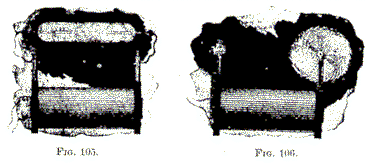
If a test tube, provided with external electrodes and exhausted to the
highest possible degree, be connected to the terminals of the coil, Fig. 9 /
105, the electrodes of the tube are instantly brought to a high temperature and
the glass at each end of the tube is rendered intensely phosphorescent, but the
middle appears comparatively dark, and for a while remains cool.
When the frequency is so high that the discharge shown in
Fig. 7 / 103 is, observed, considerable dissipation no doubt occurs in the
coil. Nevertheless the coil may be
worked for a long time, as the heating is gradual.
In spite of the fact that the difference of potential may be
enormous, little is felt when the discharge is passed through the body,
provided the hands are armed. This is
to some extent due to the higher frequency, but principally to the fact that
less energy is available externally, when the difference of potential reaches
an enormous value, owing to the circumstance that, with the rise of potential,
the energy absorbed in the coil increases as the square of the potential. Up to a certain point the energy available
externally increases with the rise of potential, then it begins to fall off
rapidly. Thus, with the ordinary high
tension induction coil, the curious paradox exists, that, while with a given
current through the primary the shock might be fatal, with many times that
current it might be perfectly harmless, even if the frequency be the same. With high frequencies and excessively high
potentials when the terminals are not connected to bodies of some size,
practically all the energy supplied to the primary is taken up by the coil. There is no breaking through, no local
injury, but all the material, insulating and conducting, is uniformly heated.
To avoid misunderstanding in regard to the physiological
effect of alternating currents of very high frequency, I think it necessary to state
that, while it is an undeniable fact that they are incomparably less dangerous
than currents of low frequencies; it should not be thought that they are
altogether harmless. What has just been
said refers only to currents from an ordinary high tension induction coil,
which currents are necessarily very small; if received directly from a machine
or from a secondary of low resistance, they produce more or less powerful
effects, and may cause serious injury, especially when used in conjunction with
condensers.
The streaming discharge of a high tension induction coil
differs in many respects from that of a powerful static machine. In color it has neither the violet of the
positive, nor the brightness of the negative, static discharge, but lies
somewhere between, being, of course, alternatively positive and negative. But since the streaming is more powerful
when the point or terminal is electrified positively, than when electrified
negatively, it follows that the point of the brush is more like the positive,
and the root more like the negative, static discharge. In the dark, when the brush is very
powerful, the root may appear almost white.
The wind produced by the escaping streams, though it may be very
strong—often indeed to such a degree that it may be felt quite a distance from
the coil—is, nevertheless, considering the quantity of the discharge, smaller
than that produced by the positive brush of a static machine, and it affects
the flame much less powerfully: From the nature of the phenomenon we can
conclude that the higher the frequency, the smaller must, of course, be the
wind produced by the streams, and with sufficiently high frequencies no wind at
all would be produced at the ordinary atmospheric pressures. With frequencies obtainable by means of a
machine, the mechanical effect is sufficiently great to revolve, with
considerable speed, large pin-wheels, which in the dark present beautiful
appearance owing to the abundance of the streams (Fig. 10).
In general, most of the experiments usually performed with a
static machine can be performed with an induction coil when operated with very
rapidly alternating currents. The
effects produced, however, are much more striking; being of incomparably
greater power. When a small length of
ordinary cotton covered wire, Fig. 11, is attached to one terminal of the coil,
the streams issuing from all points of the wire may be so intense as to produce
a considerable light effect. When the
potentials and frequencies are very high,
a wire insulated with gutta percha or rubber and attached to one of the
terminals, appears to be covered with a luminous film A very thin bare wire
when attached to a terminal emits powerful streams and vibrates continually to
and fro or spins in a circle, producing a singular effect (Fig. 12). Some of these experiments have been
described by me in The Electrical World, of
February 21, 1891.
Another peculiarity of the rapidly alternating discharge of
the induction coil is its radically different behavior with respect to points
and rounded surfaces.
If a thick wire, provided with a ball at one end and with a
point at the other, be attached to the positive terminal of a static machine,
practically all the charge will be lost through the point, on account of the
enormously greater tension, dependent on the radius of curvature. But if such a wire is attached to one of the
terminals of the induction coil, it, will be observed that with very high
frequencies streams issue from the ball almost as copiously as from the point
(Fig. 13).
It is hardly conceivable that we could produce such a
condition to an equal degree in a static machine, for the simple reason, that
the tension increases as the square of the density, which in turn is
proportional to the radius of curvature; hence, with a steady potential an
enormous charge would be required to make streams issue from a polished ball
while it is connected with a point. But
with. an induction coil the discharge
of which alternates with great rapidity it is different: Here we have to deal
with two distinct tendencies. First,
there is the tendency to escape which exists in a condition of rest, and which
depends on the radius of curvature; second, there is the tendency to dissipate
into the surrounding air by condenser action, which depends on the
surface. When one of these tendencies
is at a maximum, the other is at a minimum.
At the point the luminous stream is principally due to the air molecules
coming bodily in contact with the point; they are attracted and repelled,
charged and discharged, and, their atomic charges being thus disturbed; vibrate
and emit light waves. At the ball, on
the contrary, there is no doubt that the effect is to a great extent produced
inductively, the air molecules not necessarily
coming in contact with the ball, though they undoubtedly do so. To convince ourselves of this we only need
to exalt the condenser action, for instance, by enveloping the ball, at some
distance, by a better conductor than the surrounding medium, the conductor
being, of course, insulated; or else by surrounding it with a better dielectric
and approaching an insulated conductor; in both cases the streams will break
forth more copiously. Also, the larger
the ball with a given frequency, or the higher the frequency, the more will the
ball have the advantage over the point.
But, since a certain intensity of action is required to render the
streams visible, it is obvious that in the experiment described the ball should
not be taken too large.
In consequence of this two-fold tendency, it is possible to
produce by means of points, effects identical to those produced by
capacity. Thus, for instance, by
attaching to one terminal of the coil a small length of soiled wire, presenting
many points and offering great facility to escape, the potential of the coil
may be raised to the same value as by attaching to the terminal a polished ball
of a surface many times greater than that of the wire.
An interesting experiment, showing the effect of the points,
may be performed in the following manner: Attach to one of the terminals of the
coil a cotton covered wire about two feet in length, and adjust the conditions
so that streams issue from the wire. In
this experiment the primary coil should be preferably placed so that it extends
only about half way into the
secondary coil. Now touch the free
terminal of the secondary with a conducting object held in the hand, or else
connect it to an insulated body of some size.
In this manner the potential on the wire may be enormously raised. The effect of this will be either to
increase, or to diminish, the streams: If they increase, the wire is too short;
if they diminish, it is too long. By
adjusting the length of the wire, a point is found where the touching of the
other terminal does not at all affect the streams. In this case the rise of potential is exactly counteracted by the
drop through the coil. It will be
observed that small lengths of wire produce considerable difference in the
magnitude and luminosity of the streams.
The primary coil is placed sidewise for two reasons: First, to increase
the potential at the wire: and, second, to,increase the drop through the
coil. The sensitiveness is thus
augmented.
There is still another and far more striking peculiarity of
the brush discharge produced by very rapidly alternating currents. To observe this it is best to replace the
usual terminals of the coil by two metal columns insulated with a good
thickness of ebonite. It is also well
to close all fissures and cracks with wax so that the brushes cannot form anywhere
except at the tops of the
columns. If the conditions are
carefully adjusted—which, of course, must be left to the skill of the
experimenter—so that the potential rises to an enormous value, one may produce
two powerful brushes several inches long, nearly white at their roots, which in
the dart: bear a striking resemblance two flames of a gas escaping under
pressure (Fig. 14). But they do not
only resemble, they are veritable flames, for they are
hot. Certainly they are not as hot as a
gas burner, but they would be so if the
frequency and the potential would be sufficiently high. Produced with, say, twenty thousand
alternations per second, the heat is easily perceptible even if the potential
is not excessively high. The heat
developed is, of course, due to the impact of the air molecules against the
terminals and against each other. As,
at the ordinary pressures, the mean free path is excessively small, it is
possible that in spite of the enormous initial speed imparted to each molecule
upon coming in contact with the terminal, its progress—by collision with other
molecules—is retarded to such an extent, that it does not get away far from the
terminal, but may strike the same many times in succession. The higher the frequency, the less the
molecule is able to get away, and this the more so, as for a given effect the
potential required is smaller; and a frequency is conceivable—perhaps even
obtainable—at which practically the same molecules would strike the
terminal. Under such conditions the
exchange of the molecules would be very slow, and the heat produced at, and
very near, the terminal would be excessive.
But if the frequency would go on increasing constantly, the heat
produced would begin to diminish for obvious reasons. In the positive brush of a static machine the exchange of the
molecules is very rapid, the stream is constantly of one direction, and there
are fewer collisions; hence the heating effect must be very small. Anything that impairs the facility of
exchange tends to increase the local heat produced. Thus, if a bulb be held over the terminal of the coil so as to
enclose the brush, the air contained in the bulb is very quickly brought to a
high temperature. If a, glass tube be
held over the brush so as to allow the draught to carry the brush upwards,
scorching hot air escapes at the top of the tube. Anything held within the brush is, of course, rapidly heated, and
the possibility of using such heating effects for some purpose or other suggests
itself.
When contemplating this singular phenomenon of the hot
brush, we cannot help being convinced that a similar process must take place in
the ordinary flame, and it seems strange that after all these centuries past of
familiarity with the flame, now, in this era of electric lighting and heating;
we are finally led to recognize, that since time immemorial we have, after all,
always had "electric light and: heat" at our disposal. It is also of no little interest to
contemplate, that we have a possible way of producing—by other than chemical
means—a veritable flame; which would give light and heat without any material
being consumed, without any chemical process taking place, and to accomplish
this, we only need to perfect methods of producing enormous frequencies and
potentials. I have no doubt that if the
potential could be made to alternate with sufficient rapidity and power, the
brush formed at the end of a wire would lose its electrical characteristics and
would become flamelike. The flame must be
due to electrostatic molecular action.
This phenomenon now explains in a manner which can hardly be
doubted the frequent accidents occurring in storms. It is well known that objects are often set on fire without the
lightning striking them. We shall
presently see how this can happen. On a
nail in a roof, for instance, or on a projection of any kind, more or less
conducting, or rendered so by dampness, a powerful brush may appear. If the lightning strikes somewhere in .the
neighborhood the enormous potential may be made to alternate or fluctuate
perhaps many million times a second.
The air molecules are violently attracted and repelled, and by their
impact produce such a powerful heating effect that a fire is started. It is
conceivable that a ship at sea may, in this manner, catch fire at many points
at once. When we consider, that even
with the comparatively low frequencies obtained from a dynamo machine, and with
potentials of no more than one or two hundred thousand volts, the heating
effects are considerable, we may imagine how much more powerful they must be
with frequencies and potentials many times greater: and the above explanation
seems, to say the least, very probable.
Similar explanations may have been suggested, but I am not aware that, up
to the present; the heating effects of a brush produced by a rapidly
alternating potential have been experimentally demonstrated, at least not to
such a remarkable degree.
By preventing completely the exchange of the air molecules,
the local heating effect may be so exalted as to bring a body to
incandescence. Thus, for instance, if a
small button, or preferably a very thin wire or filament be enclosed in an
unexhausted globe and connected with the terminal of the coil, it may be
rendered incandescent. The phenomenon
is made much more interesting by the rapid spinning round in a circle of the
top of the filament, thus presenting the appearance of a luminous funnel, Fig.
15, which widens when the potential is increased. When the potential is small the end of the filament may perform
irregular motions, suddenly changing from one to the other, or it may describe
an ellipse; but when the potential is very high it always spins in a circle;
and so does generally a thin straight wire attached freely to the terminal of
the coil. These motions are, of course,
due to the impact of the molecules, and the irregularity. in the distribution of the potential, owing
to the roughness and dissymmetry of the wire or filament. With a perfectly symmetrical and polished
wire such motions would probably not occur.
That the motion is not likely to be due to other causes is evident from
the fact that it is not of a definite direction, and that in a very highly
exhausted globe it ceases altogether.
The possibility of bringing a body to incandescence in an exhausted
globe, or even when not at all enclosed, would seem to afford a possible way of
obtaining light effects, which, in perfecting methods of producing rapidly
alternating potentials, might be rendered available for useful purposes,
In employing a commercial coil; the production of very
powerful brush effects is attended with considerable difficulties, for when
these high frequencies and enormous potentials are used, the best insulation is
apt to give way. Usually the coil is
insulated well enough to stand the strain from convolution to convolution,
since two double silk covered paraffined wires will withstand a pressure of
several thousand volts; the difficulty lies principally in preventing the
breaking through from the secondary to the primary, which is greatly
facilitated by the streams issuing from the latter. In the coil, of course, the strain is greatest from section to
section„ but usually in a larger coil there are so many sections that the
danger of a sudden giving way is not
very great. No difficulty will
generally be encountered in that direction, and besides, the liability of
injuring the coil internally is very much reduced by the fact that the effect
most likely to be produced is simply a gradual heating, which, when far enough
advanced, could not fail to be observed.
The principal necessity is then to prevent the streams between he
primary and the tube, not only on account of the heating and possible injury,
but also because the streams may diminish very considerably the potential
difference available at the terminals.
A few hints as to how this may be accomplished will probably be found
useful in most of these experiments with the ordinary induction coil.
One of the ways is to wind a short primary, Fig. 16a, so
that the difference of potential is not at that length great enough to cause
the breaking forth of the streams through the insulating tube. The length of the primary should be
determined by experiment. Both the ends
of the coil should be brought out on one end through a plug of insulating
material fitting in the tube as illustrated.
In such a disposition one terminal of the secondary is attached to a
body, the surface of which is determined with the greatest care so as to
produce the greatest rise in the potential.
At the other terminal a powerful brush appears, which may be
experimented upon.
The above plan necessitates the employment of a primary of
comparatively small size, and it is apt to heat when powerful effects are
desirable for a certain length of time.
In such a case it is better to employ a larger coil, Fig. 16b, and
introduce it from one side of the tube, until the streams begin to appear. In this case the nearest terminal of the
secondary may be connected to the primary or to the ground, which is
practically the same thing, if the primary is connected directly to the
machine. In the case of ground
connections it is well to determine experimentally the frequency which is best
suited under the conditions of the test.
Another way of obviating the streams, more or less, is to make the
primary in sections and supply it from separate, well insulated sources.
In many of these experiments, when powerful effects are
wanted for a short time, it is advantageous to use iron cores with the
primaries. In such case a very large
primary coil may be wound and placed side by side with the secondary, and, the
nearest terminal of the latter being connected to the primary, a laminated iron
core is introduced through the primary into the secondary as far as the streams
will permit. Under these conditions an
excessively powerful brush, several inches long, which may be appropriately
called "St. Elmo's hot fire", may be caused to appear at the other
terminal of the secondary, producing striking effects. It is a most powerful ozonizer, so powerful
indeed, that only a few minutes are sufficient to fill the whole room with the
smell of ozone, and it undoubtedly possesses the quality of exciting chemical
affinities.
For the production of ozone, alternating currents of very
high frequency are eminently suited, not only on account of the advantages they
offer in the way of conversion but also because of the fact, that the ozonizing
action of a discharge is dependent on the frequency as well as on the
potential, this being undoubtedly confirmed by observation.
In these experiments if an iron core is used it should be
carefully watched, as it is apt to get excessively hot in an incredibly short
time. To give an idea of the rapidity
of the heating, I will state, that by passing a powerful current through a coil
with many turns, the inserting within the same of a thin iron wire for no more
than one seconds time is sufficient to heat the wire to something like 100oC.
But this rapid heating need not discourage us in the use of
iron cores in connection with rapidly alternating currents. I have for a long time been convinced that
in tile industrial distribution by means of transformers, some such plan as the
following might be practicable. We may
use a comparatively small iron core, subdivided, or perhaps not even
subdivided. We may surround this core
with a considerable thickness of material which is fire-proof and conducts the
heat poorly, and on top of that we may place the primary and secondary
windings. By using either higher
frequencies or greater magnetizing forces, we may by hysteresis and eddy
currents heat the iron core so far as to bring it nearly to its maximum
permeability, which, as Hopkinson has shown, may be as much as sixteen times
greater than that at ordinary temperatures.
If the iron core were perfectly enclosed, it would not be deteriorated
by the heat, and, if the enclosure of fire-proof material would be sufficiently
thick, only a limited amount of energy cculd be radiated in spite of the high
temperature. Transformers have been constructed
by me on that plan, but for lack of time, no thorough tests have as yet been
made.
Another way of adapting the iron core to rapid alternations,
or, generally speaking, reducing the frictional losses, is to produce by
continuous magnetization a flow of something like seven thousand or eight
thousand lines per square centimetre through the core, and then work with weak
magnetizing forces and preferably high frequencies around the point of greatest
permeability. A higher efficiency of
conversion and greater output are obtainable in this manner. I have also employed this principle in
connection .with machines in which there is no reversal of polarity. In these types of machines, as long as there
are only few pole projections, there is no great gain; as the maxima and minima
of magnetization are far from the point of maximum permeability; but when the
number of the pole projections is very great, the required rate of change may
be obtained, without the magnetization varying so far as to depart greatly from
the point of maximum permeability, and the gain is considerable.
The above described arrangements refer only to the use of
commercial coils as ordinarily constructed.
If it is desired to construct a coil for the express purpose of
performing with it such experiments as I have described, or, generally,
rendering it capable of withstanding the greatest possible difference of
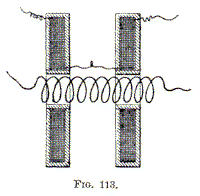
potential, then a construction as indicated in Fig. 17 / 113 will be found of
advantage. The coil in this case is
formed of two independent parts which are wound oppositely, the connection
between both being made near the primary.
The potential in the middle being zero, there is not much tendency to
jump to the primary and not much insulation is required. In some cases the middle point may, however,
be connected to the primary or to the ground.
In such a coil the places of greatest difference of potential are far
apart and the coil is capable of withstanding an enormous strain. The two parts may be movable so as to allow
a slight adjustment of the capacity effect.
As to the manner of insulating the coil, it will be found
convenient to proceed in the following way: First, the wire should be boiled in
paraffine until all the air is out; then the coil is wound by running the wire
through melted paraffine, merely for the purpose of fixing the wire. The coil is then taken off from the spool,
immersed in a cylindrical vessel filled with pure melted wax and boiled for a
long time until the bubbles cease to appear.
The whole is then left to cool down thoroughly, and then the mass is
taken out of the vessel and turned up in a lathe. A coil made in this manner and with care is capable of
withstanding enormous potential differences.
It may be found convenient to immerse the coil in paraffine
oil or some other hind of oil; it is a most effective way of insulating,
principally on account of the perfect exclusion of air, but it may be found
that, after all, a vessel filled with oil is not a very convenient thing to
handle in a laboratory.
If an ordinary coil can be dismounted, the primary may be
taken out of the tube and the latter plugged up at one end, filled with oil,
and the primary reinserted. This
affords an excellent insulation and prevents the formation of the streams.
Of all the experiments which may be performed with rapidly
alternating currents the most interesting are those which concern the
production of a practical illuminant.
It cannot be denied that the present methods, though they were brilliant
advances, are very wasteful. Some
better methods must be invented, some more perfect apparatus devised. Modern research has opened new possibilities
for the production of an efficient source of light, and the attention of all
has been turned in the direction indicated by able pioneers. Many have been carried away by the
enthusiasm and passion to discover, but in their zeal to reach results, some
have been misled. Starting with the
idea of producing electro-magnetic waves, they turned their attention, perhaps,
too much to the study of electro-magnetic effects, and neglected the study of
electrostatic phenomena. Naturally,
nearly every investigator availed himself of an apparatus similar to that used
in earlier experiments. But in those
forms of apparatus, while the electro-magnetic inductive effects are enormous,
the electrostatic effects are excessively small.
In the Hertz experiments, for instance, a high tension
induction coil is short circuited by an arc, the resistance of which is very
small, the smaller, the more capacity is attached to the terminals; and the
difference of potential at these is enormously diminished: On the other hand,
when the discharge is not passing between the terminals, the static effects may
be considerable, but only qualitatively so, not quantitatively, since their
rise and fall is very sudden, and since their frequency is small. In neither case, therefore, are powerful
electrostatic effects perceivable.
Similar conditions exist when, as in some interesting experiments of Dr.
Lodge, Leyden jars are discharged disruptively. It has been thought—and I believe asserted—that in such cases
most of the energy is radiated into space.
In the light of the experiments which I have described above, it will
now not be thought so. I feel safe in
asserting that in such cases most of the energy is partly taken up and
converted into heat. in the arc of the
discharge and in the conducting and insulating material of the jar, some energy
being, of course, given off by electrification of the air; but the amount of
the directly radiated energy is very small.
When a high tension induction coil, operated by currents
alternating only 20,000 times a second, has its terminals closed through even a
very small jar, practically all the energy passes through the dielectric of the
jar, which is heated, and the electrostatic effects manifest themselves
outwardly only to a very weak degree.
Now the external circuit of a Leyden jar, that is, the arc and the
connections of the coatings, may be looked upon as a circuit generating
alternating currents of excessively high frequency and fairly high potential,
which is closed through the coatings and the dielectric between them, and from
the above it is evident that the external electrostatic effects must be very
small, even if a recoil circuit be used.
These conditions make it appear that with the apparatus usually at hand,
the observation of powerful electrostatic effects was impossible, and what
experience has been gained in that direction is only due to the great ability
of the investigators.
But powerful electrostatic effects are a sine qua non of light production on the lines indicated by
theory. Electro-magnetic effects are
primarily unavailable, for the reason that to produce the required effects we
would have to pass current impulses through a conductor; which, long before the
required frequency of the impulses could be reached, would cease to transmit
them. On the other hand,
electro-magnetic waves many times longer than those of light, and producible by
sudden discharge of a condenser, could not be utilized, it would seem, except
we avail ourselves of their effect upon conductors as in the present methods,
which are wasteful. We could not affect
by means of such waves the static molecular or atomic charges of a gas, cause
them to vibrate and to emit light. Long
transverse waves cannot, apparently, produce such effects, since excessively
small electro-magnetic disturbances may pass readily through miles of air. Such dark waves, unless they are of the
length of true light waves, cannot, it would seem, excite luminous radiation in
a Geissler tube; and the luminous effects, which are producible by induction in
a tube devoid of electrodes, I am inclined to consider as being of an
electrostatic nature.
To produce such luminous effects, straight electrostatic
thrusts are required; these, whatever be their frequency, may disturb the
molecular charges and produce light.
Since current impulses of the required frequency cannot pass through a
conductor of measurable dimensions, we must work with a gas, and then the
production of powerful electrostatic effects becomes an imperative necessity.
It has occurred to me, however, that electrostatic effects
are in many ways available for the production of light. For instance, we may place a body of some
refractory material in a closed; and preferably more or less exhausted, globe,
connect it to a source of high, rapidly alternating potential, causing the
molecules of the gas to strike it many times a second at enormous speeds, and in
this manner, with trillions of invisible hammers, pound it until it, gets
incandescent: or we may place a body in a very highly exhausted globe, in a
non-striking vacuum, and, by employing very high frequencies and potentials,
transfer sufficient energy from it to other bodies in the vicinity, or in
general to the surroundings, to maintain it at any degree of incandescence; or
we may, by means of such rapidly alternating high potentials, disturb the ether
carried by the molecules of a gas or their static charges, causing them to
vibrate and to emit light.
But, electrostatic effects being dependent upon the
potential and frequency, to produce the most powerful action it is desirable to
increase both as far as practicable. It
may be possible to obtain quite fair results by keeping either of these factors
small, provided the other is sufficiently great; but we are limited in both
directions. My experience demonstrates
that we cannot go below a certain frequency, for, first, the potential then
becomes so great that it is dangerous; and, secondly, the light production is
less efficient.
I have found that, by using the ordinary low frequencies,
the physiological effect of the current required to maintain at a certain
degree of brightness a tube four feet long, provided at the ends with outside
and inside condenser coatings, is so powerful that, I think, it might produce
serious injury to those not accustomed to such shocks: whereas, with twenty
thousand alternations per second, the tube may be maintained at the same degree
of brightness without any effect being felt.
This is due principally to the fact that a much smaller potential is
required to produce the same light effect, and also to the higher efficiency in
the light production. It is evident
that the efficiency in such cases is the greater, the higher the frequency, for
the quicker the process of charging and discharging the molecules, the less
energy will be lost in the form of dark radiation. But, unfortunately, we cannot go beyond a certain frequency on
account of the difficulty of producing and conveying the effects.
I have stated above that a body inclosed in an unexhausted
bulb may be intensely heated by simply connecting it with a source of rapidly
alternating potential. The heating in
such a case is, in all probability, due mostly to the bombardment of the
molecules of the gas contained in the bulb.
When the bulb is exhausted, the heating of the body is much more rapid,
and there is no difficulty whatever in bringing a wire or filament to any degree
of incandescence by simply connecting it to one terminal of a coil of the
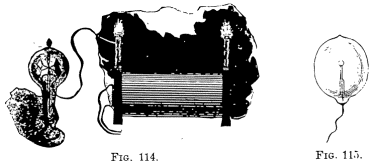
proper dimensions. Thus, if the
well-known apparatus of Prof. Crookes, consisting of a bent platinum wire with
vanes mounted over it (Fig. 18 / 114), be connected to one terminal of the
coil—either one or both ends of the platinum wire being connected—the wire is
rendered almost instantly incandescent, and the mica vanes are rotated as
though a current from a battery were used: A thin carbon filament, or,
preferably, a button of some refractory material (Fig. 19 / 115), even if it be
a comparatively poor conductor, inclosed in an exhausted globe, may be rendered
highly incandescent; and in this manner a simple lamp capable of giving any
desired candle power is provided.
The success of lamps of this kind would depend largely on
the selection of the light-giving bodies contained within the bulb. Since, under the conditions described,
refractory bodies—which are very poor conductors and capable of withstanding
for a long time excessively high degrees of temperature—may be used, such
illuminating devices may be rendered successful.
It might be thought at first that if the bulb, containing
the filament or button of refractory material, be perfectly well exhausted—that
is, as far as it can be done by the use of the best apparatus—the heating would
be much less intense, and that in a perfect vacuum it could not occur at
all. This is not confirmed by my experience; quite the contrary,
the better the vacuum the more easily the bodies are brought to
incandescence. This result is
interesting for many reasons.
At the outset of this work the idea presented itself to me,
whether two bodies of refractory material enclosed in a bulb exhausted to such
a degree that the discharge of a large induction coil, operated in the usual
manner, cannot pass through, could be rendered incandescent by mere condenser
action. Obviously, to reach this result
enormous potential differences and very high frequencies are required, as is
evident from a simple calculation.
But such a lamp would possess a vast advantage over an
ordinary incandescent lamp in regard to efficiency. It is well-known that the efficiency of a lamp is to some extent a
function of the degree of incandescence, and that, could we but work a filament
at many times higher degrees of incandescence, the efficiency would be much
greater. In an ordinary lamp this is
impracticable on account of the destruction of the filament, and it has been
determined by experience how far it is advisable to push the
incandescence. It is impossible to tell
how much higher efficiency could be obtained if the filament could withstand
indefinitely, as the investigation to this end obviously cannot be carried
beyond a certain stage; but there are reasons for believing that it would be
very considerably higher. An
improvement might be made in the ordinary lamp by employing a short and thick
carbon; but then the leading-in wires would have to be thick, and, besides,
there ace many other considerations which render such a modification entirely
impracticable. But in a lamp as above
described, the leading-in wires may be very small, the incandescent refractory
material may be in the shape of blocks offering a very small radiating surface,
so that less energy would be required to keep them at the desired
incandescence; and in addition to this, the refractory material need not be
carbon, but may be manufactured from mixtures of oxides, for instance, with
carbon or other material, or may be selected from bodies which are practically
non-conductors, and capable of withstanding enormous degrees of temperature.
All this would point to the possibility of obtaining a much
higher efficiency with such a lamp than is obtainable in ordinary lamps. In my experience it has been demonstrated
that the blocks are brought to high degrees of incandescence with much lower
potentials than those determined by calculation, and the blocks may be set at
greater distances from each other. We
may freely assume, and it is probable, that the molecular bombardment is an
important element in the heating, even if the globe be exhausted with the
utmost care, as I have done; for although the number of the molecules is,
comparatively speaking, insignificant, yet on account of the mean free path
being very great, there are fewer collisions, and the molecules may reach much
higher speeds, so that the heating effect due to this cause may be
considerable, as in the Crookes experiments with radiant matter.
But it is likewise possible that we have to deal here with
an increased facility of losing the charge in very high vacuum, when the
potential is rapidly alternating, in which case most of the heating would be
directly due to the surging of the charges in the heated bodies. Or else the observed fact may be largely
attributable to the effect of the points which I have mentioned above, in
consequence of which the blocks or filaments contained in the vacuum are
equivalent to condensers of many times greater surface than that calculated
from their geometrical dimensions.
Scientific men still differ in opinion as to whether a charge should, or
should not, be lost in a perfect vacuum, or.
in other words, whether ether is, or is not, a conductor. If the former were the case, then a thin
filament enclosed in a perfectly exhausted globe, and connected to a source of
enormous, steady potential, would be brought to incandescence.
Various forms of lamps on the above described principle,
with the refractory bodies in the form of filaments, Fig. 20, or blocks, Fig.
21, have been constructed and operated by me, and investigations are being
carried on in this line. There is no
difficulty in reaching such high degrees of incandescence that ordinary carbon
is to all appearance melted and volatilized.
If the vacuum could be made absolutely perfect, such a lamp, although
inoperative with apparatus ordinarily used, would, if operated with currents of
the required character, afford an illuminant which would never be destroyed,
and which would be far more efficient than an ordinary incandescent lamp. This perfection can, of course, never be
reached; and a very slow destruction and gradual diminution in size always
occurs, as in incandescent filaments; but there is no possibility of a sudden
and premature disabling which occurs in the latter by the breaking of the
filament, especially when the incandescent bodies are in the shape of blocks.
With these rapidly alternating potentials there is, however,
no necessity of enclosing two blocks in a globe, but a single block, as in Fig.
19, or filament, Fig. 22, may be used.
The pctential in this case must of course be higher, but is easily
obtainable, and besides it is not necessarily dangerous.
The facility with which the button or filament in such a
lamp is brought to incandescence, other things being equal, depends on the size
of the globe. If a perfect ,vacuum
could be obtained, the size of the globe would not be of importance, for then
the heating would be wholly due to the surging of the charges, and all the
energy would be given off to the surroundings by radiation. But this can never occur in practice. There is always some gas left in the globe,
and although the exhaustion may be carried to the highest degree, still the
space inside of the bulb must be considered as conducting when such high
potentials are used, and I assume that, in estimating the energy that may be
given off from the filament to the surroundings, we may consider the inside
surface of the bulb as one coating of a condenser, the air and other objects
surrounding the bulb forming the other coating. When the alternations are very low there is no doubt that a
considerable portion of the energy is given off by the electrification of the
surrounding air.
In order to study this subject better, I carried on some
experiments with excessively high potentials and low frequencies. I then observed that when the hand is
approached to the bulb,—the filament being connected with one terminal of the
coil,—a powerful vibration is felt, being due to the attraction and repulsion
of the molecules of the air which are electrified by induction through the
glass. In some cases when the action is
very intense I have been able to hear a sound, which must be due to the same
cause.
When the alternations are low, one is apt to get an
excessively powerful shock from the bulb.
In general, when one attaches bulbs or objects of some size to the
terminals of the coil, one should look out for the rise of potential, for it may
happen that by merely connecting a bulb or plate to the terminal, the potential
may rise to many times its original value.
When lamps are attached to the terminals, as illustrated in Fig. 23,
then the capacity od the bulbs should be such as to give the maximum rise of
potential under the existing conditions.
In this manner one may obtain the required potential with fewer turns of
wire.
The life of such lamps as described above depends, of
course, largely on the degree of exhaustion, but to some extent also on the
shape of the block of refractory material.
Theoretically it would seem that a small sphere of carbon enclosed in a
sphere of glass would not suffer deterioration from molecular bombardment, for,
the matter in the globe being radiant, the molecules would move in straight
lines, and would seldom strike the sphere obliquely. An interesting thought in connection with such a lamp is, that in
it "electricity" and electrical energy apparently must move in the
same lines.
The use of alternating currents of very high frequency makes
it possible to transfer, by electrostatic or electromagnetic induction through
the glass of a lamp, sufficient energy to keep a filament at incandescence and
so do away with the leading-in wires.
Such lamps have been proposed, but for want of proper apparatus they
have not been successfully operated.
Many forms of lamps on this principle with continuous and broken
filaments have been constructed by me and experimented upon. When using a secondary enclosed within the
lamp, a condenser is advantageously combined with the secondary. When the transference is effected by
electrostatic induction, the potentials used are, of course, very high with
frequencies obtainable from a machine.
For instance, with a condenser surface of forty square centimetres,
which is not impracticably large, and with glass of good quality I mm. thick, using currents alternating twenty
thousand times a second, the potential required is approximately 9,000 volts. This may seem large, but since each lamp may
be included in the secondary of a transformer of very small dimensions, it
would not be inconvenient, and, moreover, it would not produce fatal
injury. The transformers would all be
preferably in series. The regulation
would offer no difficulties, as with currents of such frequencies it is very
easy to maintain a constant current.
In the accompanying engravings some of the types of lamps of
this kind are shown. Fig. 24 is such a
lamp with a broken filament, and Figs. 25a and 25b one with a single outside
and inside coating and a single filament.
I have also made lamps with two outside and inside coatings and a
continuous loop connecting the latter.
Such lamps have been operated by me with current impulses of the
enormous frequencies obtainable by the disruptive discharge of condensers.
The disruptive discharge of a condenser is especially suited
for operating such lamps—with no outward electrical connections—by means of
electromagnetic induction, the electromagnetic inductive effects being excessively
high; and I have been able to produce the desired incandescence with only a few
short turns of wire. Incandescence may
also be produced in this manner in a simple closed filament.
Leaving now out of consideration the practicability of such
lamps, I would only say that they possess a beautiful and desirable feature,
namely, that they can be rendered, at will, more or less brilliant simply by
altering the relative position of the outside and inside condenser coatings, or
inducing and induced circuits.
When a lamp is lighted by connecting it to one terminal only
of the source, this may be facilitated by providing the globe with an outside
condenser coating, which serves at the same time as a reflector, and connecting
this to an insulated body of some size.
Lamps of this kind are illustrated in Fig. 26 and Fig. 27. Fig. 28 shows the plan of connection. The brilliancy of the lamp may, in this
case, be regulated within wide limits by varying the size of the insulated
metal plate to which the coating is connected.
It is likewise practicable to light with one leading wire
lamps such as illustrated in Fig. 20 and Fig. 21, by connecting one terminal of
the lamp to one terminal of the source, and the other to an insulated body of
the required size. In all cases the
insulated body serves to give off the energy into the surrounding space, and is
equivalent to a return wire. Obviously,
in the two last-named cases, instead of connecting the wires to an insulated body,
connections may be made to the ground.
The experiments which will prove most suggestive and of most
interest to the investigator are probably those performed with exhausted
tubes. As might be anticipated, a
source of such rapidly alternating potentials is capable of exciting the tubes
at a considerable distance, and the light effects produced are remarkable.
During my investigations in this line I endeavored to excite
tubes, devoid of any electrodes, by electromagnetic induction, snaking the tube
the secondary of the induction device, and passing through the primary the
discharges of a Leyden jar. These tubes
were made of many shapes, and I was able to obtain luminous effects which I
then thought were due wholly to electromagnetic induction. But on carefully investigating the phenomena
I found that the effects produced were more of an electrostatic nature. It may be attributed to this circumstance
that this mode of exciting tubes is very wasteful, namely, the primary circuit
being closed, the potential, and consequently the electrostatic inductive
effect, is much diminished.
When an induction coil, operated as above described, is
used, there is no doubt that the tubes are excited by electrostatic induction,
and that electromagnetic induction has little, if anything, to do with the
phenomena.
This is evident from many experiments. For instance, if a tube be taken in one
hand, the observer being near the coil, it is brilliantly lighted and remains
so no matter in what position it is held relatively to the observer's
body. Were the action electromagnetic,
the tube could not be lighted when the observer's body is interposed between it
and the coil, or at least its luminosity should be considerably
diminished. When the tube is held
exactly over the centre of the coil—the latter being wound in sections and the
primary placed symmetrically to the secondary—it may remain completely dark,
whereas it is rendered intensely luminous by moving it slightly to the right or
left from the centre of the coil. It does
not light because in the middle both halves of the coil neutralize each other,
and the electric potential is zero. If
the action were electromagnetic, the tube should light best in the plane
through the centre of the toil, since the electromagnetic effect there should
be a maximum. When an arc is
established between the terminals, the tubes and lamps in the vicinity of the
coil go out, out light up again when the arc is broken, on account of the rise
of potential. Yet the electromagnetic
effect should be practically the same in both cases.
By placing a tube at some distance from the coil, and nearer
to one terminal—preferably at a point on the axis of the coil—one may light it
by touching the remote terminal with an insulated body of some size or with the
hand, thereby raising the potential at that terminal nearer to, the tube. If the tube is shifted nearer to the coil so
that it is lighted by the action of the nearer terminal, it may be made to go
out by holding, on an insulated support, the end of a wire connected to the
remote terminal, in the vicinity of the nearer terminal, by this means
counteracting the action of the latter upon the tube. These effects are evidently electrostatic. Likewise, when a tube is placed it a
considerable distance from the coil, the observer may, standing upon an
insulated support between coil and tube, light the latter by approaching the
hand to it; or he may even render it luminous by simply stepping between it and
the coil. This would be impossible with
electro-magnetic induction, for the body of the observer would act as a screen.
When the coil is energized by excessively weak currents, the
experimenter may, by touching one terminal of the coil with the tube,
extinguish the latter, and may again light it by bringing it out of contact
with the terminal and allowing a small arc to form. This is clearly due to the respective lowering and raising of the
potential at that terminal. In the
above experiment, when the tube is lighted through a small arc, it may go out
when the arc is broken, because the electrostatic inductive effect alone is too
weak, though the potential may be much higher; but when the arc is established,
the electrification of the end of the tube is much greater, and it consequently
lights.
If a tube is lighted by holding it near to the coil, and in
the hand which is remote. by grasping
the tube anywhere with the other hand, the part between the hands is rendered
dark, and the singular effect of wiping out the light of the tube may he
produced by passing the hand quickly along the tube and at the same time
withdrawing it gently from the coil, judging properly tile distance so that the
tube remains dark afterwards.
If the primary coil is placed sidewise, as in Fig. 16b for
instance, and an exhausted tube be introduced from the other side in the hollow
space, the tube is lighted most intensely because of the increased condenser
action, and in this position the striae are most sharply defined. In all these experiments described, and in
many others, the action is clearly electrostatic.
The effects of screening also indicate the electrostatic
nature of the phenomena and show something of the nature of electrification
through the air. For instance, if a
tube is placed in the direction of the axis of the coil, and an insulated metal
plate be interposed, the tube will generally increase in brilliancy, or if it
be too far from the coil to light, it may even be rendered luminous by
interposing an insulated metal plate.
The magnitude of the effects depends to some extent on the size of the
plate. But if the metal plate be
connected by a wire to the ground, its interposition will always make the tube
go put even if it be very near the coil.
In general, the interposition of a body between the coil and tube, increases
or diminishes the brilliancy of the tube, or its facility to light up,
according to whether it increases or diminishes the electrification. When experimenting with an insulated plate,
the plate should not be taken too large, else it will generally produce a
weakening effect by reason of its great facility for giving off energy to the
surroundings.
If a tube be lighted at some distance from the coil, and a
plate of hard rubber or other insulating substance be interposed, the tube may
be made to go .out. The interposition
of the dielectric in this case only slightly
increases the inductive effect, but diminishes considerably the electrification
through the air.
In all cases, then, when we excite luminosity in exhausted
tubes by means of such a coil, the effect is due to the rapidly alternating
electrostatic' potential; and, furthermore, it must be attributed to the
harmonic alternation produced directly by the machine, and not to any
superimposed vibration which might be thought to exist. Such superimposed vibrations are impossible
when we work with an alternate current machine. If a spring be gradually tightened and released, it does not
perform independent vibrations; for this a sudden release is necessary. So with the alternate currents from a dynamo
machine; the medium is harmonically strained and released, this giving rise to
only one kind of waves; a sudden contact or break, or a sudden giving way of
the dielectric, as in the disruptive discharge of a Leyden jar, are essential
for the production of superimposed waves.
In all the last described experiments, tubes devoid of any
electrodes may be used, and there is no difficulty in producing by their means
sufficient light to read by. The light
effect is, however, considerably increased by the use of phosphorescent bodies
such as yttria, uranium glass, etc. A
difficulty will be found when the phosphorescent material is used, for with
these powerful effects, it is carried gradually away, and it is preferable to
use material in the form of a solid.
Instead of depending on induction at a distance to light the
tube, the same may be provided with an external—and, if desired, also with an
internal—condenser coating, and it may then be suspended anywhere in the room
from a conductor connected to one terminal of the coil, and in this manner a
soft illumination may be provided.
The ideal way of lighting a hall or room would, however, be
to produce such a condition in it that an illuminating device could be moved
and put anywhere, and that it is lighted, no matter where it is put and without
being electrically connected to anything.
I have been able to produce such a condition by creating in the room a
powerful, rapidly alternating electrostatic field. For this purpose I suspend a sheet of metal a distance from the
ceiling on insulating cords and connect it to one terminal of the induction
coil, the other terminal being preferably connected to the ground. Or else I suspend two sheets as illustrated
in Fig. 29, each sheet being connected with on;. of the terminals of the coil, and their size being carefully
determined. An exhausted tube may then
be carried in the hand anywhere between the sheets or placed anywhere, even a
certain distance beyond them; it remains always luminous.
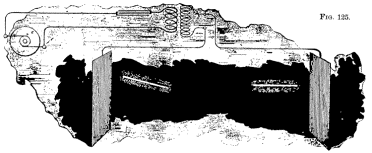
In such an electrostatic field interesting phenomena may be observed,
especially if the alternations are kept low and the potentials excessively
high. In addition to the luminous
phenomena mentioned, one may observe that any insulated conductor gives sparks
when the hand or another object is approached to it, and the sparks may often
be powerful. When a large conducting
object is fastened on an insulating support, and the hand approached to it, a
vibration, due to the rythmical motion of the air molecules is felt, and luminous
streams may be perceived when the hand is held rear a pointcd projection. When a telephone receiver is made to touch
with one or both of its terminals art insulated conductor of some size, the
telephone emits a loud sound; it also emits a sound when a length of wire is
attached to one or both terminals, and with very powerful fields a sound may be
perceived even without any wire.
How far this principle is capable of practical application,
the future will tell. It might be
thought that electrostatic effects are unsuited for such action at a distance. Electromagnetic inductive effects, if
available for the production of light, might be thought better suited. It is true the electrostatic effects
diminish nearly with the cube of the distance from the coil, whereas the
electromagnetic inductive effects diminish simply with the distance. But when we establish an electrostatic field
of force, the condition is very different, for then, instead of the
differential effect of both the terminals, we get their conjoint effect. Besides, I would call attention to the
effect that in an alternating electrostatic field, a conductor, such as an
exhausted tube, for instance, tends to take up most of the energy, whereas in
an electromagnetic alternating field the conductor tends to take up the least
energy, the waves being reflected with but little loss. This is one reason why it is difficult to
excite an exhausted tube, at a distance, by electromagnetic induction. I have wound coils of very large diameter
and of many turns of wire, and connected a Geissler tube to the ends of the
coil with the object of exciting the tube at a distance; but even with the
powerful inductive effects producible by Leyden jar discharges, the tube could
not be excited unless at a very small distance, although some judgment was used
as to the dimensions of the coil. I
have also found that even the most powerful Leyden jar discharges are capable
of exciting only feeble luminous effects in a closed exhausted tube, and even
these effects upon thorough examination I have been forced to consider of an
electrostatic nature.
How then can we hope to produce the required effects at a
distance by means of electromagnetic action, when even in the closest proximity
to the source of disturbance, under the most advantageous conditions, we can
excite but faint luminosity? It is true
that when acting at a distance we have the resonance to help us out. We can connect an exhausted tube, or
whatever the illuminating device may be, with an insulated system of the proper
capacity, and so it may be possible to increase the effect qualitatively, and
only qualitatively, for we would not get snore
energy through the device. So we
may, by resonance effect, obtain the required electromotive force in an
exhausted tube, and excite faint luminous effects, but we cannot get enough
energy to render the light practically available, and a simple calculation,
based on experimental results, shows that even if all the energy which a tube
would receive at a certain distance from the source should be wholly converted
into light, it would hardly satisfy the practical requirements. Hence the necessity of directing, by means
of a conducting circuit, the energy to the place of transformation. But in so doing we cannot very sensibly
depart from present methods, and all we could do would be to improve the
apparatus.
From these considerations it would seem that if this ideal
way of lighting is to rendered practicable it will be only by the use of
electrostatic effects. In such a case
the most powerful electrostatic inductive effects are needed; the apparatus
employed must, therefore, be capable of producing high electrostatic potentials
changing in value with extreme rapidity.
High frequencies are especially wanted, for practical considerations
make it desirable to keep down the potential.
By the employment of
machines, or, generally speaking, of any mechanical apparatus, but low
frequencies can be reached; recourse must, therefore, be had to some other
means.The discharge of a condenser affords us a means of obtaining frequencies
by far higher than are obtainable mechanically, and I have accordingly employed
condensers in the experiments to the above end.
When the terminals of a high tension induction coil, Fig.
30, are connected to a Leyden jar, and the latter is discharging disruptively
into a circuit, we may look upon the arc playing between the knobs as being a
source of alternating, or generally speaking, undulating currents, and then we
have to deal with the familiar system of a generator of such currents, a
circuit connected to it, and a condenser bridging the circuit. The condenser in such case is a veritable
transformer, and since the frequency is excessive, almost any ratio in the
strength of the currents in both the branches may be obtained.. In reality the analogy is not quite
complete, for in the disruptive discharge we have most generally a fundamental
instantaneous variation of comparatively low frequency, and a superimposed
harmonic vibration, and the laws governing the flow of currents are not the:
same for both.
In converting in this manner, the ratio of conversion should
not be too great, for the loss in the arc between the knobs increases with the
square of the current, and if the jar be discharged through very thick and
short conductors, with the view of obtaining a very rapid oscillation, a very
considerable portion of the energy stored is lost. On the other hand, too small ratios are not practicable for many
obvious reasons.
As the converted currents flow in a practically closed
circuit, the electrostatic effects are necessarily small, and I therefore
convert them into currents or effects of the required character. I have effected such conversions in several
ways. The preferred plan of connections
is illustrated in Fig. 31. The manner
of operating renders it easy to obtain by means of a small and inexpensive
apparatus enormous differences of potential which have been usually obtained by
means of large and expensive coils. For
this it is only necessary to take an ordinary small coil, adjust to it a condenser
and discharging circuit, forming the primary of an auxiliary small coil, and
convert upward. As the inductive effect
of the primary currents is excessively great, the second coil need have
comparatively but very few turns. By
properly adjusting the elements, remarkable results may be secured.
In endeavoring to obtain the required electrostatic effects
in this manner, I have, as might be expected, encountered many difficulties
which I have been gradually overcoming, but I am not as yet prepared to dwell
upon my experiences in this direction.
I believe that the disruptive discharge of a condenser will
play an important part in the future, for it offers vast possibilities, not
only in the way of producing light in a more efficient manner and in the line
indicated by theory, but also in many other respects.
For years the efforts of inventors have been directed
towards obtaining electrical energy from heat by means of the thermopile. It might seem invidious to remark that but
few know what is the real trouble with the thermopile. It is not the inefficiency or small
output—though these are great drawbacks—but the fact that the thermopile has
its phylloxera, that is, that by constant use it is deteriorated, which has
thus far prevented its introduction on an industrial scale. Now that all modern research seems to point
with certainty to the use of electricity of excessively high tension, the
question must present itself to many whether it is not possible to obtain in a
practicable manner this form of energy from heat. We have been used to look upon an electrostatic machine as a
plaything, and somehow we couple with it the idea of the inefficient and
impractical. But now we must think
differently, for now we know that everywhere we have to deal with the same
forces, and that it is a mere question of inventing proper methods or apparatus
for rendering them available.
In the present systems of electrical distribution, the
employment of the iron with its wonderful magnetic properties allows us to
reduce considerably the size of the apparatus; but, in spite of this, it is
still very cumbersome. The more we
progress in the study of electric and magnetic phenomena, the more we become
convinced that the present methods will be short-lived. For the production of light, at least, such
heavy machinery would seem to be unnecessary.
The energy required is very small, and if light can be obtained as
efficiently as, theoretically, it appears possible, the apparatus need have but
a very small output. There being a strong
probability that the illuminating methods of the future will involve the use of
very high potentials, it seems very desirable to perfect a contrivance capable
of converting the energy of heat into energy of the requisite form. Nothing to speak of has been done towards
this end, for the thought that electricity of some 50,000 or 100,000 volts
pressure or more, even if obtained, would be unavailable for practical
purposes, has deterred inventors from working in this direction.
In Fig. 30 a plan of connections is shown for converting
currents of high, into currents of low, tension by means of the disruptive
discharge of a condenser. This plan has
been used by me frequently for operating a few incandescent lamps required in
the laboratory. Some difficulties have
been encountered in the arc of the discharge which I have been able to overcome
to a great extent; besides this, and the adjustment necessary for the proper
working, no other difficulties have been met with, and it was easy to operate
ordinary lamps; and even motors, in this manner. The line being connected to the ground, all the wires could be
handled with perfect impunity, no matter how high the potential at the
terminals of the condenser. In these
experiments a high tension induction coil, operated from a battery or from an
alternate current machine, was employed to charge the condenser; but the
induction coil might be replaced by an apparatus of a different kind, capable
of giving electricity of such high tension.
In this manner, direct or alternating currents may be converted, and in
both cases the current-impulses may be of any desired frequency. When the currents charging the condenser are
of the same direction, and it is desired that the converted currents should
also be of one direction, the resistance of the discharging circuit should, of
course, be so chosen that there are no oscillations.
In operating devices on the above plan I have observed
curious phenomena of impedance which are of interest. For instance if a thick copper bar be bent, as indicated in Fig.
32, and shunted by ordinary incandescent lamps, then, by passing the discharge
between the knobs, the lamps may be brought to incandescence although they are
short-circuited. When a large induction
coil is employed it is easy to obtain nodes on the bar, which are rendered
evident by the different degree of brilliancy of the lamps, as shown roughly in
Fig. 32. The nodes are never clearly
defined, but they are simply maxima and minima of potentials along the
bar. This is probably due to the
irregularity of the arc between the knobs.
In general when the above-described plan of conversion from high to low
tension is used, the behavior of the disruptive discharge may be closely
studied. The nodes may also be
investigated by means of an ordinary Cardew voltmeter which should be well
insulated. Geissler tubes may also be
lighted across the points of the bent bar; in this case, of course, it is
better to employ smaller capacities. I
have found it practicable to light up in this manner a lamp, and even a
Geissler tube, shunted by a short,
heavy block of metal, and this result seems at first very curious. In fact, the thicker the copper bar in Fig.
32; the better it is for the success of the experiments, as they appear more
striking. When lamps with long slender
filaments are used it will be often noted that the filaments are from time to
time violently vibrated, the vibration being smallest at the nodal points. This vibration seems to be due to an
electrostatic action between the filament and the glass of the bulb.
In some of the above experiments it is preferable to use
special lamps having a straight filament as shown in Fig. 33. When such a lamp is used a still more
curious phenomenon than those described may be observed. The lamp may be placed across the copper bar
and lighted, and by using somewhat larger capacities, or, in other words,
smaller frequencies or smaller impulsive impedances, the filament may be
brought to any desired degree of incandescence. But when the impedance is increased, a point is reached when
comparatively little current passes through the carbon, and most of it through
the rarefied gas; or perhaps it may be more correct to state that the current
divides nearly evenly through both, its spite of the enormous difference in the
resistance, and this would be true unless the Las and the filament behave
differently. It is then noted that the
whole bulb is brilliantly illuminated, and the ends of the leading-in wires become
incandescent and often throw off sparks in consequence of the violent
bombardment, but the carbon filament remains dark. This is illustrated in Fig. 33.
Instead of the filament a single wire extending through the whole bulb
may be used, and in this case the phenomenon would seen to be still more
interesting.
From the above experiment it will be evident, that when
ordinary lamps are operated by the converted currents, those should be
preferably taken in which the platinum wires are far apart, and the frequencies
used should not be too great, else the discharge will occur at the ends of the
filament or in the base of the lamp between the leading-in wires, and the lamp
might then be damaged.
In presenting to you these results of my investigation on
the subject under consideration, I have paid only a passing notice to facts
upon which I could have dwelt at length, and among many observations I have
selected only those which I thought most likely to interest you. The field is wide and completely unexplored,
and at every step a new truth is gleaned, a novel fact observed.
How far the results here borne out are capable of practical
applications will be decided in the future.
As regards the production of light, some results already reached are
encouraging and make me confident in asserting that the practical solution of
the problem lies in the direction I have endeavored to indicate. Still, whatever may be the immediate outcome
of these experiments I am hopeful that they will only prove a step in further
developments towards the ideal and final perfection. The possibilities which are opened by modern research are so vast
that even the most reserved must feel sanguine of the future. Eminent scientists consider the problem of
utilizing one kind of radiation without the others a rational one. In an apparatus designed for the production
of light by conversion from any form of energy into that of light, such a
result can never be reached, for no matter what the process of producing the
required vibrations, be it electrical, chemical or any other, it will not be
possible to obtain the higher light vibrations without going through the lower
heat vibrations. It is the problem of
imparting to a body a certain velocity without passing through all lower
velocities. But there is a possibility
of obtaining energy not only in the form of light, but motive power, and energy
of any other form, in some more direct way from the medium. The time will be when this will be
accomplished, and the time has come when one may utter such words before an
enlightened audience without being considered a visionary. We are whirling through endless space with
an inconceivable speed, all around us everything is spinning, everything is
moving, everywhere is energy. There mart be some way of availing ourselves
of this energy more directly. Then;
with the light obtained from the medium, with the power derived from it, with
every form of energy obtained without effort, from the store forever
inexhaustible, humanity will advance with giant strides. The mere contemplation of these magnificent
possibilities expands our minds, strengthen our hopes and fills our hearts with
supreme delight.